



Collection: Plastic Ball Bearings: The Complete Guide to Materials, Types, Applications, and Selection

Plastic ball bearings are lightweight, corrosion-resistant bearing solutions designed for applications where traditional metal bearings may not be the best fit. Unlike standard steel ball bearings, plastic ball bearings can offer excellent resistance to moisture, chemicals, washdown environments, and non-magnetic operating conditions. For OEMs, distributors, maintenance teams, and equipment manufacturers, choosing the right plastic ball bearing can reduce weight, simplify maintenance, and improve performance in specific operating environments.
This guide explains the main materials, structures, advantages, limitations, applications, and selection factors of plastic ball bearings. It is written for industrial buyers who need to understand when plastic ball bearings are suitable, how they compare with metal bearings, and what details should be confirmed before purchasing or developing a custom bearing solution.
What Are Plastic Ball Bearings?
Plastic ball bearings are rolling bearings that use plastic materials for one or more main components, such as the inner ring, outer ring, cage, or sometimes the balls. In many designs, the rings are made from engineering plastics, while the balls may be made from glass, stainless steel, ceramic, or plastic. This combination gives plastic ball bearings different performance characteristics from conventional chrome steel or stainless steel bearings.
The most common plastic ball bearing structure includes a plastic inner ring, a plastic outer ring, a cage, and rolling balls. Depending on the application, the bearing may be fully plastic, partially plastic, or designed with hybrid materials. For example, a plastic bearing with glass balls may be used in lightweight and corrosion-resistant applications, while a plastic bearing with stainless steel balls may offer better load capacity and wear performance.
Plastic ball bearings are not simply low-cost replacements for steel bearings. They are used when the operating environment requires special properties such as chemical resistance, water resistance, low weight, electrical insulation, or non-magnetic performance. In the right application, they can provide a practical and cost-effective solution.
Key Advantages of Plastic Ball Bearings
1. Corrosion Resistance
One of the biggest advantages of plastic ball bearings is their resistance to corrosion. Steel bearings can rust when exposed to water, humidity, cleaning chemicals, salt spray, or acidic environments. Plastic ball bearings can operate in many wet or corrosive environments where metal bearings may fail prematurely.
This makes them useful for food processing machinery, beverage equipment, packaging machines, marine equipment, chemical handling systems, and light-duty washdown applications. For buyers dealing with rust problems, plastic ball bearings can be an alternative to stainless steel bearings, especially when the load and speed requirements are not extremely high.
2. Lightweight Design
Plastic ball bearings are much lighter than steel bearings. This is important in applications where reducing component weight improves energy efficiency, lowers inertia, or makes equipment easier to handle. Lightweight bearing solutions are often used in conveyors, automation systems, medical devices, office equipment, and small mechanical assemblies.
3. Low Noise Operation
Plastic materials can help reduce vibration and noise in certain applications. Compared with metal-to-metal contact, plastic bearing components may provide quieter operation, especially in light-load and medium-speed systems. This makes plastic ball bearings suitable for equipment where smooth and quiet movement is important.
4. Self-Lubricating Possibilities
Some engineering plastics have good self-lubricating properties. In certain applications, plastic ball bearings can operate without additional grease or oil. This can help reduce maintenance requirements and avoid lubricant contamination.
However, buyers should not assume that every plastic ball bearing is maintenance-free. The exact lubrication requirement depends on the material, load, speed, temperature, and operating environment.
5. Electrical Insulation and Non-Magnetic Properties
Plastic ball bearings can provide electrical insulation and non-magnetic performance. This makes them useful in electronic equipment, medical devices, laboratory instruments, sensors, and applications where metal components may interfere with magnetic fields or electrical systems.
Common Materials Used in Plastic Ball Bearings
The performance of plastic ball bearings depends heavily on material selection. Different plastics have different strength, wear resistance, chemical resistance, temperature resistance, and dimensional stability. Below are some of the most common materials used in plastic ball bearing components.
POM Plastic Ball Bearings
POM, also known as acetal, is one of the most widely used engineering plastics for plastic ball bearings. It offers good mechanical strength, dimensional stability, low friction, and wear resistance. POM plastic ball bearings are commonly used in light-duty industrial equipment, conveyors, packaging machinery, furniture hardware, and small mechanical devices.
POM is a practical material when the application needs a balance between cost, strength, and performance. It is suitable for many general-purpose plastic bearing applications, but it may not be the best choice for high-temperature or highly aggressive chemical environments.
PA / Nylon Plastic Ball Bearings
PA, commonly known as nylon, is another common material used in plastic bearing components. Nylon offers good toughness, impact resistance, and wear performance. It is often selected for mechanical parts that require strength and durability.
However, nylon can absorb moisture, which may affect dimensional stability in some environments. For applications exposed to water or humidity, buyers should confirm whether nylon is suitable or whether another material such as POM, PTFE, or PEEK would perform better.
PTFE Plastic Ball Bearings
PTFE is known for its excellent chemical resistance and very low friction. PTFE plastic ball bearings are suitable for environments where resistance to chemicals, acids, solvents, or aggressive media is important. PTFE can also operate without traditional lubrication in certain applications.
The limitation of PTFE is that it generally has lower mechanical strength compared with some other engineering plastics. It is usually more suitable for special chemical or low-friction applications rather than high-load mechanical applications.
PEEK Plastic Ball Bearings
PEEK is a high-performance engineering plastic with excellent mechanical strength, temperature resistance, chemical resistance, and dimensional stability. PEEK plastic ball bearings are used in more demanding applications where standard plastic materials may not be sufficient.
PEEK is often selected for medical equipment, semiconductor equipment, chemical processing systems, high-temperature environments, and precision industrial machinery. It is more expensive than POM or nylon, but it can provide better performance in harsh or high-value applications.
UHMWPE Plastic Ball Bearings
UHMWPE offers excellent wear resistance, impact resistance, and low friction. It is often used in sliding and wear-resistant components, and it can also be used in certain plastic bearing applications. UHMWPE may be useful in food processing, packaging, and material handling systems where low friction and wear resistance are important.
Ball Materials for Plastic Ball Bearings
In plastic ball bearings, the ball material is just as important as the ring material. Different ball materials affect load capacity, noise, corrosion resistance, weight, and service life.
Glass Balls
Glass balls are commonly used in plastic ball bearings for lightweight, corrosion-resistant, and non-magnetic applications. They are suitable for low-load and light-duty environments. Glass ball bearings are often used in medical devices, laboratory equipment, light conveyors, and applications where metal contamination should be avoided.
Stainless Steel Balls
Plastic ball bearings with stainless steel balls can provide better load capacity and wear resistance than fully plastic or glass-ball designs. Stainless steel balls are useful when the application still requires corrosion resistance but also needs stronger rolling elements.
For applications exposed to moisture, cleaning agents, or mild chemicals, stainless steel balls can be a practical option. However, they may not provide the same non-magnetic or metal-free advantages as glass or ceramic balls.
Ceramic Balls
Ceramic balls, especially silicon nitride or zirconia balls, can provide excellent corrosion resistance, low weight, high hardness, and electrical insulation. Plastic ball bearings with ceramic balls are often used in specialty applications where chemical resistance, non-magnetic performance, or low friction is required.
Plastic Balls
Some plastic ball bearings use plastic balls for fully non-metallic construction. These bearings are usually used in light-load applications where corrosion resistance, low weight, and non-metallic properties are more important than high load capacity.
Main Types of Plastic Ball Bearings
Plastic Deep Groove Ball Bearings
Plastic deep groove ball bearings are the most common type of plastic ball bearing. They are designed to support radial loads and moderate axial loads in both directions. These bearings are suitable for conveyors, rollers, small machines, packaging equipment, and light-duty mechanical assemblies.
Plastic Miniature Ball Bearings
Miniature plastic ball bearings are used in compact devices, small motors, instruments, medical equipment, office equipment, and lightweight mechanisms. They are useful when small size, low weight, low noise, or corrosion resistance is required.
Plastic Flanged Ball Bearings
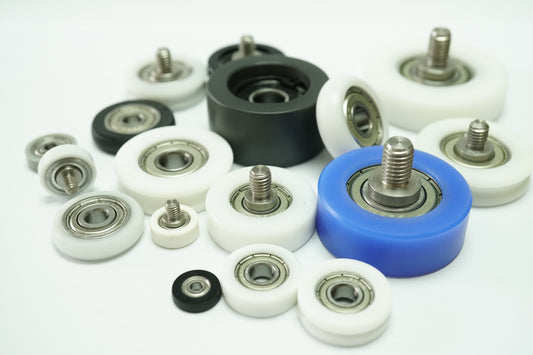
Plastic flanged ball bearings include an integrated flange on the outer ring. The flange helps locate the bearing axially and simplifies mounting in small mechanical assemblies. These bearings are often used in guide rollers, small wheels, office equipment, sliding mechanisms, and light-duty automation systems.
Plastic Thrust Ball Bearings
Plastic thrust ball bearings are designed to support axial loads. They are used in light-duty rotating systems where axial positioning is required and where metal thrust bearings may not be suitable due to corrosion, weight, or chemical exposure.
Custom Plastic Ball Bearings
Many plastic ball bearing applications require custom dimensions, special materials, non-standard ball combinations, or unique cage designs. OEMs may need custom plastic ball bearings for equipment that operates in wet, chemical, cleanroom, food-grade, or lightweight environments.
Applications of Plastic Ball Bearings
Food Processing Equipment
Food processing equipment often works in wet, humid, and washdown environments. Cleaning chemicals, water exposure, and hygiene requirements can cause standard metal bearings to rust or fail. Plastic ball bearings can be used in selected food processing equipment where corrosion resistance and lubricant-free operation are important.
Typical applications include conveyors, light-duty rollers, packaging machines, guide wheels, filling equipment, and inspection systems. Material selection is important because food-related applications may require compliance with specific safety or hygiene standards.
Medical and Laboratory Equipment
Plastic ball bearings are suitable for many medical and laboratory devices because they can be lightweight, corrosion-resistant, low-noise, and non-magnetic. They may be used in diagnostic equipment, analytical instruments, sample handling devices, and small mechanical systems.
For medical applications, buyers should confirm material compatibility, cleanliness requirements, sterilization conditions, and whether the bearing needs to operate without grease.
Chemical Processing Equipment
Chemical environments can be difficult for metal bearings, especially when acids, alkalis, solvents, or corrosive fluids are present. Plastic ball bearings made from materials such as PTFE or PEEK may be used in selected chemical processing applications where chemical resistance is the main requirement.
Because chemical compatibility varies by material and chemical concentration, the operating medium should always be confirmed before selecting a plastic ball bearing.
Conveyors and Material Handling Systems
Plastic ball bearings are widely used in light-duty conveyor systems, roller assemblies, guide wheels, sorting equipment, and packaging lines. Their lightweight design, corrosion resistance, and low noise can make them attractive for material handling equipment.
For conveyor applications, the most important selection factors include load, speed, shaft size, operating temperature, exposure to water or chemicals, and whether the bearing will be used continuously.
Marine and Wet Environments
In marine or wet environments, corrosion is a major cause of bearing failure. Plastic ball bearings can be used in light-duty marine equipment, water treatment systems, outdoor mechanisms, and components exposed to humidity or splashing water.
However, for high-load marine applications, stainless steel bearings or ceramic hybrid bearings may still be more appropriate. Plastic ball bearings should be selected based on actual load and speed requirements.
Electronic and Electrical Equipment
Plastic ball bearings can provide electrical insulation and non-magnetic performance, making them useful in electronic equipment, sensors, measuring instruments, and small devices where metal bearings may create interference.
Plastic Ball Bearings vs Metal Ball Bearings
Plastic ball bearings and metal ball bearings are not direct replacements in every situation. Each has its own strengths and limitations.
Metal ball bearings, especially chrome steel and stainless steel bearings, generally offer higher load capacity, higher speed capability, better rigidity, and longer service life in demanding mechanical applications. They are commonly used in motors, pumps, gearboxes, machinery, and high-load rotating equipment.
Plastic ball bearings are better suited for applications where corrosion resistance, low weight, chemical resistance, electrical insulation, or lubricant-free operation is more important than maximum load capacity. They are especially useful in wet, clean, chemical, or light-duty environments.
For example, if a bearing is used in a high-speed electric motor, a precision steel or ceramic hybrid bearing may be more suitable. If the bearing is used in a light-duty conveyor exposed to washdown water, a plastic ball bearing may be a better choice.
How to Choose the Right Plastic Ball Bearing
1. Confirm the Load Requirement
Plastic ball bearings are usually suitable for light to medium-duty applications. Before selecting a bearing, confirm the radial load, axial load, impact load, and whether the load is continuous or intermittent. If the load is too high, a stainless steel bearing, ceramic hybrid bearing, or metal-backed solution may be more reliable.
2. Check the Operating Speed
Speed affects friction, heat generation, wear, and bearing life. Plastic materials may have lower speed limits than steel bearings. For high-speed applications, the bearing material, ball material, clearance, lubrication, and temperature must be carefully evaluated.
3. Review Temperature Conditions
Different plastics have different temperature limits. POM and nylon are suitable for many general applications, while PEEK is better for high-temperature environments. If the bearing is exposed to heat, steam, drying equipment, or sterilization processes, material selection becomes very important.
4. Understand Chemical Exposure
If the bearing will contact acids, alkalis, solvents, cleaning chemicals, or oils, confirm chemical compatibility before ordering. PTFE and PEEK may be suitable for more aggressive chemical environments, while POM or nylon may be better for general mechanical use.
5. Decide the Ball Material
Glass balls, stainless steel balls, ceramic balls, and plastic balls each provide different performance. Glass and ceramic balls are useful for non-metallic or corrosion-resistant applications. Stainless steel balls can improve strength and durability. Plastic balls are suitable for lightweight and fully non-metallic designs.
6. Confirm Size and Mounting Design
Plastic ball bearings are available in standard metric and inch sizes, but custom dimensions are also common. Buyers should confirm bore diameter, outer diameter, width, shaft tolerance, housing tolerance, flange requirements, and whether the bearing will be press-fit or loosely installed.
7. Evaluate Lubrication Requirements
Some plastic ball bearings can operate dry, while others may perform better with special lubrication. In food, medical, or clean applications, lubricant selection may be restricted. Always confirm whether the bearing needs to be dry-running, food-grade lubricated, or sealed against contamination.
Limitations of Plastic Ball Bearings
Although plastic ball bearings offer many advantages, they are not suitable for every application. Compared with metal bearings, they usually have lower load capacity, lower stiffness, lower heat resistance, and lower precision capability. They may also deform under high load or high temperature.
For heavy-duty machinery, high-speed motors, high-precision spindles, or applications with strong impact loads, metal bearings may be a better option. Plastic ball bearings should be selected based on realistic performance requirements rather than only corrosion resistance or low cost.
When Should You Use Plastic Ball Bearings?
Plastic ball bearings are a good choice when the application requires one or more of the following properties:
- Corrosion resistance in wet or humid environments
- Resistance to cleaning chemicals or mild corrosive media
- Lightweight bearing design
- Low noise operation
- Non-magnetic or electrically insulating performance
- Lubricant-free or low-maintenance operation
- Metal-free bearing construction
- Custom bearing design for special OEM equipment
They are especially useful in food processing, packaging, medical equipment, laboratory instruments, chemical handling, conveyors, light automation, and wet environments.
Custom Plastic Ball Bearings for OEM and Industrial Buyers
Many industrial applications cannot be solved with a standard catalog bearing. OEM customers may require a specific plastic material, special ball material, unique dimensions, custom colors, special clearance, flange design, or non-standard structure. Custom plastic ball bearings can help equipment manufacturers solve problems related to corrosion, weight, noise, installation, and material compatibility.
When requesting a custom plastic ball bearing, buyers should provide as much technical information as possible, including size, load, speed, temperature, operating environment, chemical exposure, shaft and housing materials, expected service life, and any industry requirements. The more complete the application information, the easier it is to recommend the right material and structure.
Plastic Ball Bearing Selection Checklist
Before ordering plastic ball bearings, confirm the following details:
- Bearing type: deep groove, flanged, miniature, thrust, or custom
- Dimensions: bore diameter, outer diameter, and width
- Ring material: POM, PA, PTFE, PEEK, UHMWPE, or other plastics
- Ball material: glass, stainless steel, ceramic, or plastic
- Load direction: radial load, axial load, or combined load
- Operating speed and duty cycle
- Temperature range
- Exposure to water, chemicals, cleaning agents, or salt spray
- Lubrication requirement
- Noise, weight, and corrosion resistance requirements
- Quantity, packaging, and delivery requirements
Conclusion
Plastic ball bearings are practical bearing solutions for applications where corrosion resistance, lightweight design, chemical resistance, low noise, electrical insulation, or non-metallic construction is important. They are commonly used in food processing equipment, medical devices, conveyors, packaging machines, chemical environments, marine equipment, and light-duty industrial systems.
The most important factor in selecting plastic ball bearings is material compatibility. POM, nylon, PTFE, PEEK, UHMWPE, glass balls, stainless steel balls, ceramic balls, and plastic balls all provide different advantages. A bearing that performs well in one application may not be suitable for another.
For OEMs, distributors, and industrial buyers, the best approach is to evaluate the application first: load, speed, temperature, chemical exposure, mounting design, and service life expectations. With the correct material and structure, plastic ball bearings can provide a reliable, corrosion-resistant, and cost-effective solution for many specialized applications.
